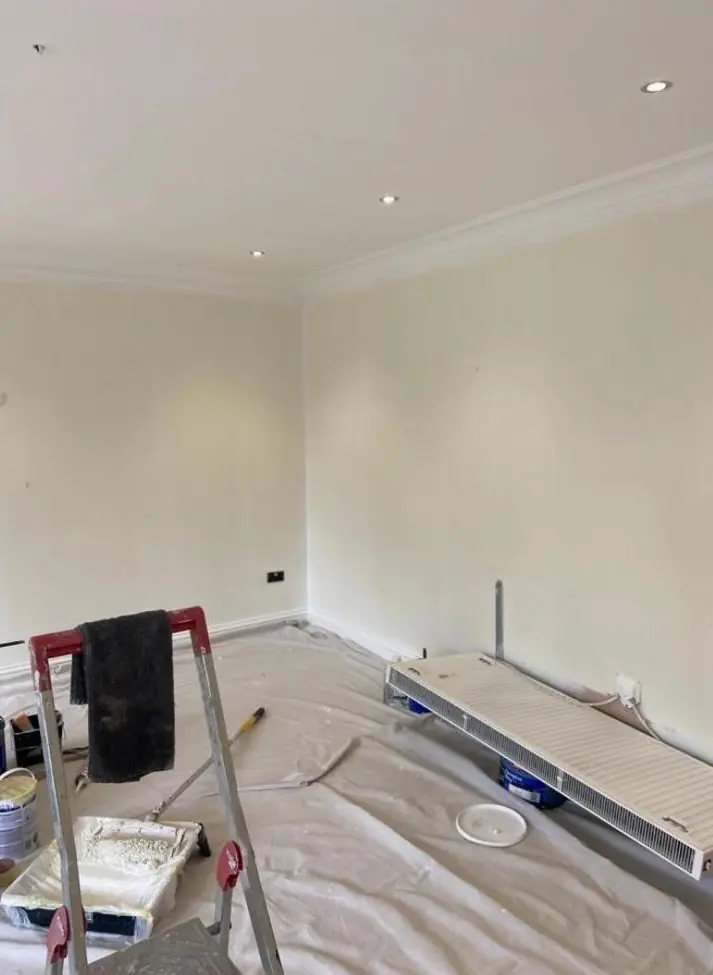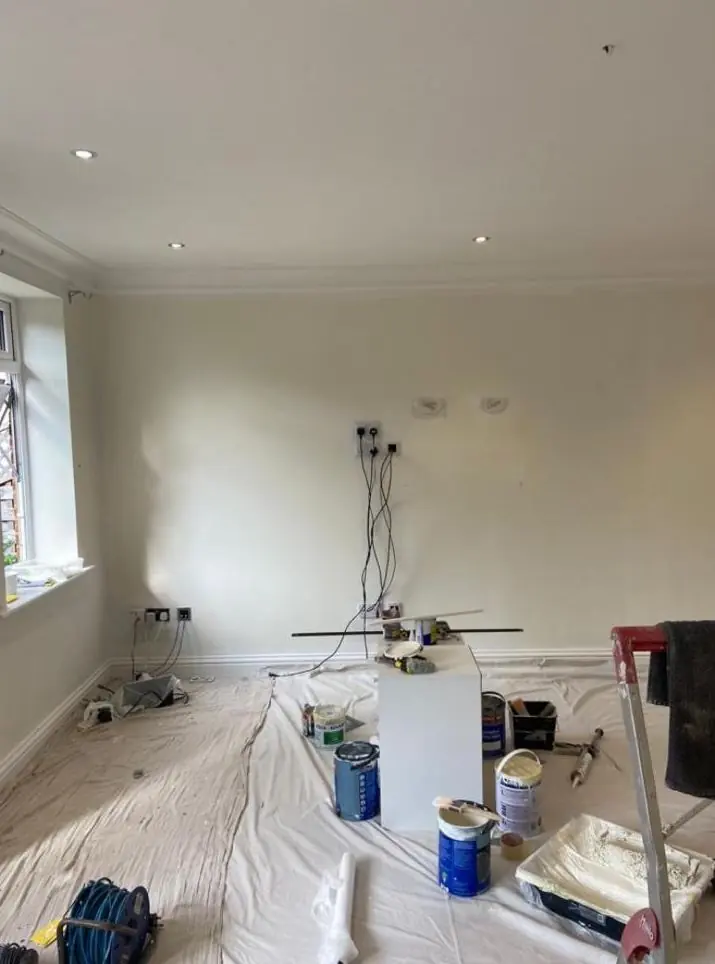
We hang wallpaper in St Crispin, about 2.6 miles west of Northampton town centre in the NN5 postcode. The usual jobs here are feature walls and long drops: three-storey townhouse stairwells and the tall walls inside flats converted from the old county hospital.
The stairwell drop is the hard part
Many of the newer houses in St Crispin are three-storey townhouses with two flights of stairs and one tall void running up through the middle. Papering that void is a different job from papering a bedroom. A single length can run from the top landing ceiling down past the half-landing, so every roll has to be checked for the batch number and enough paper ordered to allow for pattern repeat on long cuts.
We set up a stair platform so the lengths can be hung and smoothed at height without leaning off a ladder. The plumb line is marked from the top, because on a wall that tall even a small lean at the ceiling grows into an obvious slope by the time it reaches the hall floor. Where the void meets the landing ceiling, the trim line needs to be dead straight; it is the first thing you see from the bottom step.
Tall walls in the old hospital buildings
Flats converted from the Victorian blocks, including Keystone House and the former superintendent’s house, have high ceilings and large arched-head sash windows. That gives you tall walls broken up by deep reveals. Papering around a reveal takes time: each return is cut and wrapped so the pattern on the face of the wall still lines up after the corner.
Walls in converted buildings can also be uneven where old and new plaster meet. Hanging a lining paper first, crossways to the finish paper, gives a sound and even base and stops the joints of a heavy paper from opening up later. On a wall with decorative plasterwork above, the top cut is made below the moulding so the original detail stays clear.
Feature walls in a home that is still drying
Some homes in St Crispin are only a few years old, and more are coming: consent exists for 235 dwellings on the remaining hospital core. New plaster has to be fully dry and sealed before any paper goes on, otherwise the paste can lift or the paper can stain. In a recently completed house we would usually suggest:
- waiting until the plaster has dried evenly in colour across the whole wall;
- sizing the wall so the paste does not soak straight in;
- choosing a chimney-breast-style feature wall or a dormer gable rather than a whole stairwell, so if the house settles and cracks the repair is small.
Dormer rooms on the top floor of a townhouse make an interesting place for a bold paper, since the angled ceiling frames the wall. They do need careful cutting along the slope.
Shared parking courts are common on the estate, and long rolls, pasting tables and a stair platform take some unloading. We agree a spot for the van with you beforehand so the gear can come straight in without crowding a neighbour’s bay.
Getting started
Dean will look at the walls, measure the drops and tell you how many rolls to order before you buy. If an old paper needs stripping first, he will check what is underneath; in older converted rooms the plaster behind can be fragile and may need repair before anything new is hung. The full process, from stripping to the final trim, is set out on our wallpaper hanging service page, and the St Crispin area page covers the other decorating work we take on locally.
Last updated by Dean, DH Painter & Decorator.