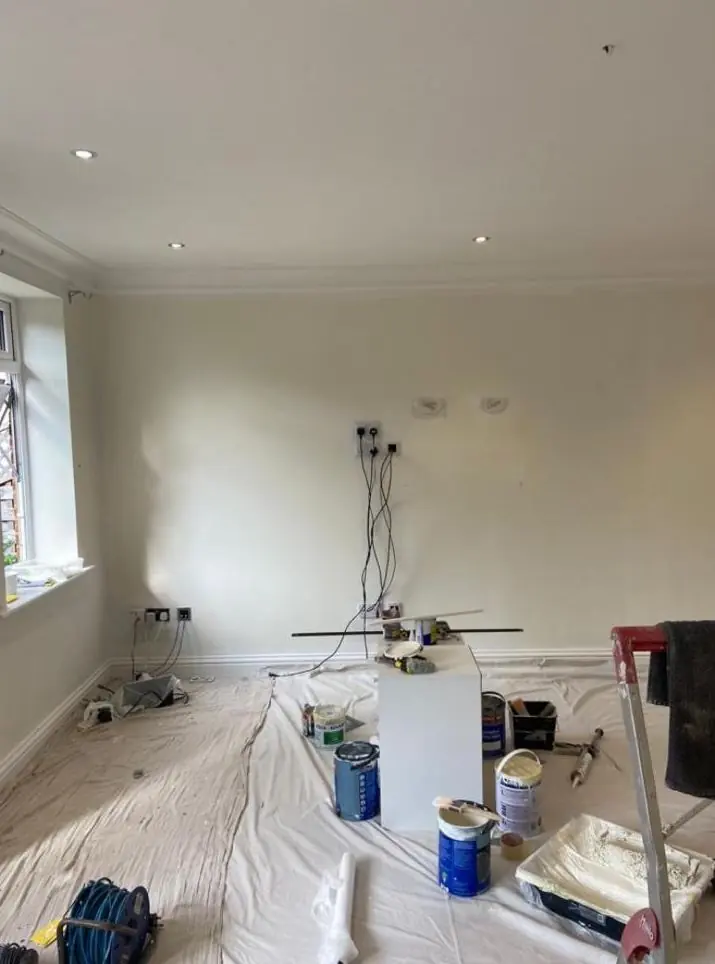
Dean paints interiors in East Haddon, a village in the NN6 postcode about 7.3 miles north-west of Northampton town centre, off the A428. Most of the older rooms here sit behind lias, limestone or rendered cob walls dating from the 1600s and 1700s, so the work centres on breathable paints, careful prep of lime plaster and painting round beams and leaded windows.
Rooms behind 17th-century datestones
The Gardeners House on Ravensthorpe Road has a 1655 datestone; Walcott House on Main Street, one of the younger listed cottages, is dated 1748. Rooms in houses of that age were plastered in lime, not gypsum, and the walls follow the stone or cob behind them. Expect bowed surfaces, rounded corners, ceilings that dip between beams, and window reveals that are deep enough to sit in.
None of that is a fault to be ironed out. Our job inside these cottages is to keep the character while giving you clean, even colour, which means filling only what is cracked or loose and leaving the gentle undulation of the wall alone. Skimming an old lime wall flat with modern filler usually looks wrong and can trap moisture behind it.
Why vinyl emulsion is the wrong default on old lime walls
The coursed lias and limestone walls here, and the rendered cob at houses such as Nos 4 and 5 Main Street, rely on moisture being able to move through them and out again. Standard vinyl matt and silk emulsions form a fairly closed skin. On a lime-plastered wall that can lead to blistering, flaking and damp patches that never quite dry.
So before we quote, Dean checks what is already on the walls. Where the plaster is lime and the existing coating is breathable, we recommend a mineral paint, a clay paint or a breathable emulsion, and on some ceilings a soft distemper. Where a cottage has already had layers of modern emulsion, we talk through whether to work over it or take it back, because a breathable topcoat over a sealed layer gains you very little.
- Lime plaster in good order: breathable emulsion or mineral paint, two coats.
- Old distempered ceilings: distemper again, since most emulsions will not bond to it.
- Gypsum plaster in later extensions: a mist coat and ordinary emulsion are fine.
Beams, leaded lights and the slow parts of the job
Low ceilings with exposed timbers mean a lot of cutting in. Beams are left as they are unless you ask otherwise, and the ceiling between them is painted by brush in short sections. Leaded glass set in stone mullions, which you find at The Gardeners House and The Hall Flats, is never painted. The plaster reveals around them are, so the leaded glass is masked and the stone protected before any brush goes near it.
In small cottage rooms we also plan around furniture that cannot leave the room, because narrow cottage stairs and doorways often stop a sofa or wardrobe going anywhere. We move what will move, sheet the rest and work one wall at a time.
Formal rooms in the larger houses
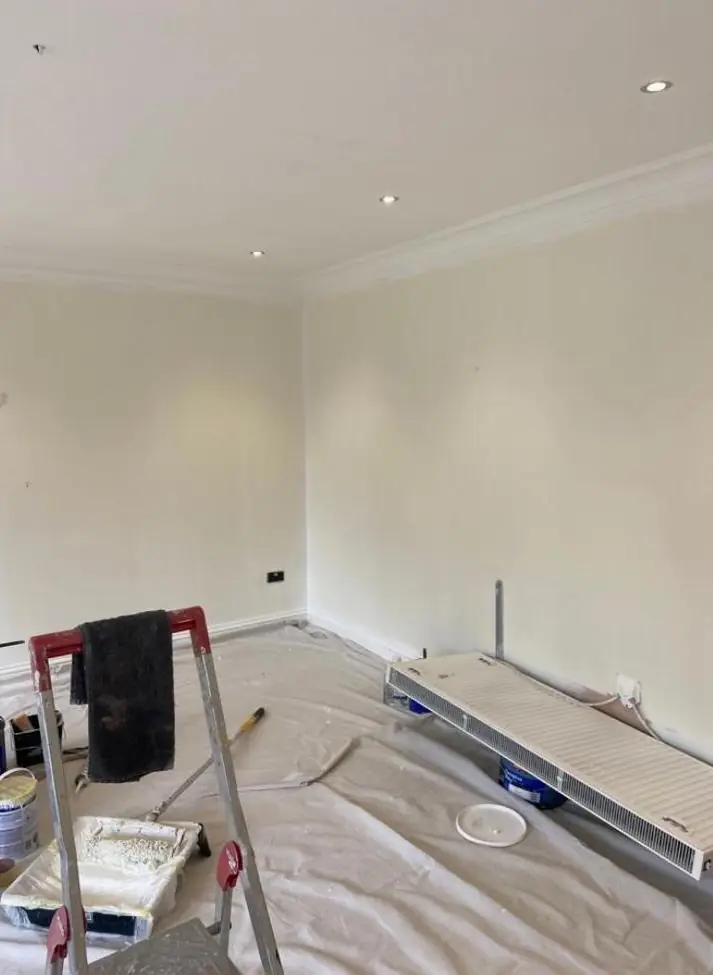
At the other end of the scale, East Haddon Hall (built about 1780) and the bigger 18th-century houses have higher ceilings, sash windows with glazing bars and, in some rooms, panelling. Here the challenge is reach and finish. Tall walls need a tower, and panelling needs the mouldings cleaned and keyed so new paint does not fill the detail. In a listed house, removing or altering historic panelling or decorative plaster can need listed building consent from West Northamptonshire Council, so we stick to redecorating what is there.
Booking a quote from Northampton
We drive out along the A428, and the old houses front straight onto Main Street, so we agree where the van can wait without blocking the road. Dean looks at every room, tests the existing paint where needed and gives you a written quote. For our general approach to rooms and woodwork, see the main interior painting service. Cost factors are covered in the decorating cost guide, and the rest of our village work is on the East Haddon page.
Last updated by Dean, DH Painter & Decorator.