Dean hangs wallpaper and lining paper in Great Doddington, about 8.3 miles east of Northampton in the Nene Valley. The village's old limestone cottages have bowed walls and sloping attic ceilings that make pattern choice and setting out matter, while its 20th-century houses are far more straightforward to paper.
Stone walls are rarely plumb
The oldest houses in Great Doddington’s conservation area were built of coursed limestone in the 1600s and 1700s, and their internal walls follow the stone. Expect a wall to lean out at the top, a corner to be a gentle curve rather than a sharp angle, and a chimney breast to be a few centimetres wider at floor level than at the ceiling. Paper does not hide any of this. A vertical stripe hung true to a plumb line will drift away from a leaning corner, and one hung to the corner will look tilted against the window frame.
Dean sorts this out before the first length goes up. He checks every wall with a level and decides where the eye will judge the pattern from, usually the main window, door or fireplace. The setting-out starts there, and any drift is pushed into the least visible corner, often behind a door or in an alcove. On very uneven walls, a cross-lined base of lining paper evens out small hollows and gives the finished paper something consistent to grip.
Attic rooms under the old roofs
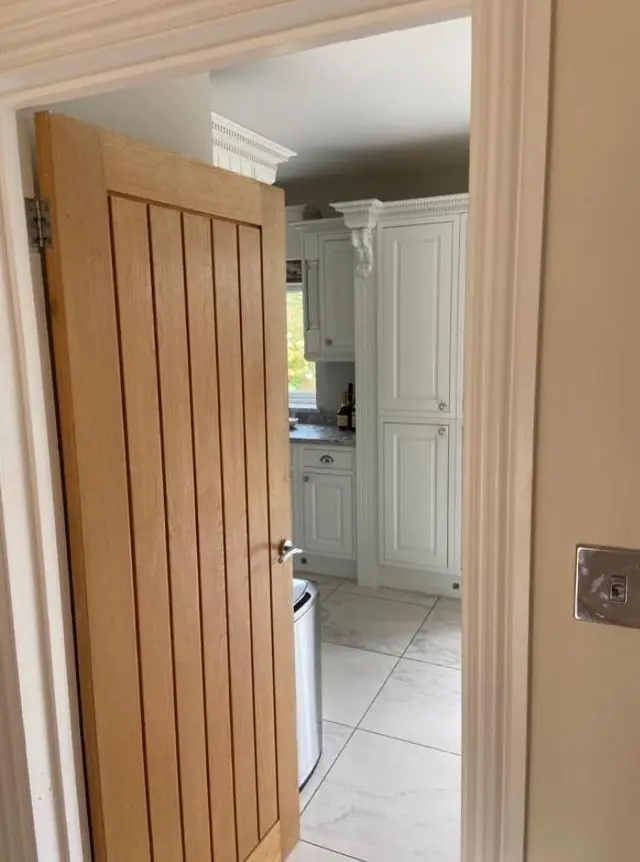
Several of the listed cottages are described as single-storey with attics or two storeys with attics, which in practice means bedrooms with sloping ceilings that come down to knee walls, dormer windows with their own small reveals, and very little straight wall to work with. Papering a room like this involves far more cutting than papering a box room of the same size. Each slope meets a vertical wall at its own angle, and a dormer turns one flat surface into five.
There are two common ways to handle it. One is to paper the slopes and walls all in the same small, all-over design so the angles disappear. The other is to paper only the vertical walls and paint the slopes and ceiling, which keeps the joins out of sight. Dean will talk you through which suits your room before you order paper, and our colour advice can help match a paint for the slopes to the paper.
Patterns that forgive, and patterns that don’t
For the stone-built houses, this list is a good starting point when choosing paper:
- Works well: small random or scattered motifs, textured and woven-effect papers, florals with no strong vertical, and plain papers with a slight surface texture.
- Harder going: regimented stripes, large geometric repeats and anything with a strong horizontal line that will be measured against an uneven ceiling.
- Check first: heavy vinyls on walls that may be lime plaster. A vinyl face slows moisture movement in the same way vinyl paint does, so a breathable paper or a paint finish can be the safer choice on a solid stone wall.
Buy a few extra rolls if you’ve chosen a large repeat. Extra waste goes into matching across leaning walls, and a reprint from a different batch can vary in shade.
Bungalows, infill and the newer houses
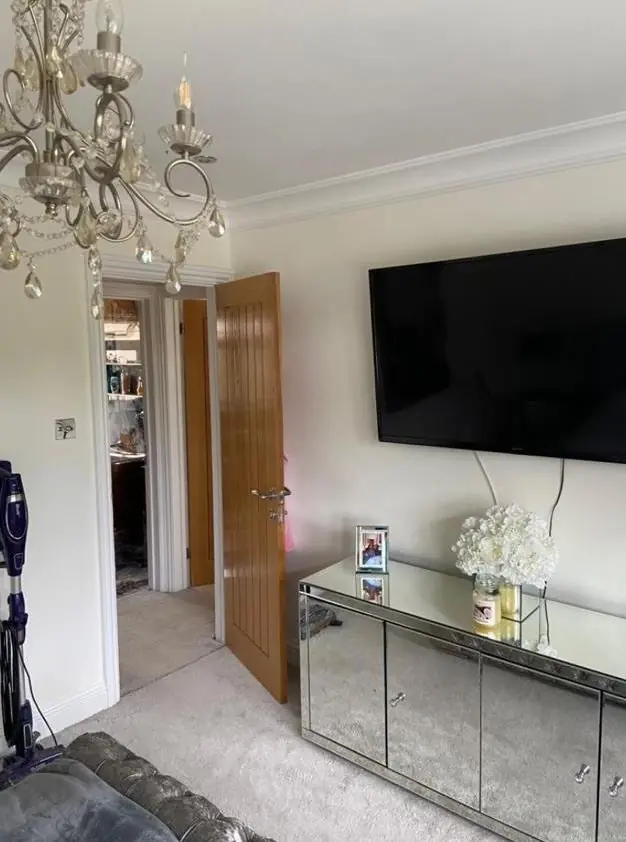
Away from the old core, the picture changes. Bungalows from the 1960s/70s scheme at 44 to 54 High Street, St Nicholas Court and the ribbon houses stretching towards Earls Barton have plastered or plasterboard walls that are close to flat, so bolder papers and feature walls are much easier there. The main work is usually stripping what is already up, which can be several layers in a 50-year-old house, and making good any damage underneath before hanging. Our main wallpaper hanging page covers the stripping, lining and hanging process in full.
Great Doddington is about 8.3 miles east of our Northampton base, and we cover the whole village, from the cottages near St Nicholas’ Church out to the newest houses. If a room also needs painting around the paper, it can be booked as one job. You’ll find more on the village’s houses on our Great Doddington page.
Last updated by Dean, DH Painter & Decorator.