
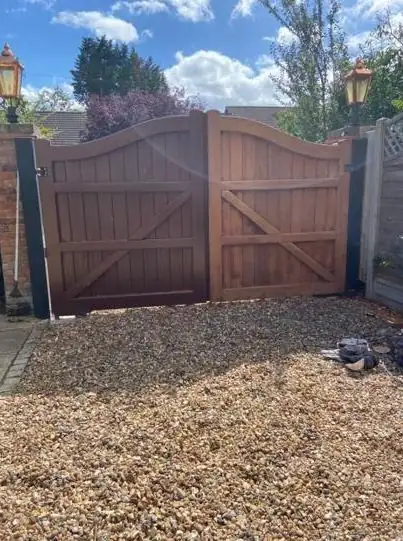
Fence and gate staining in Kislingbury has to deal with wet ground: the soil is mostly clay over mudstone, and parts of the village have a high chance of surface-water flooding. Dean cleans, prepares and stains fences, gates and garden timber, from long boundaries on detached plots to gates set into old stone walls, 3.6 miles west of Northampton.
| Fact | Detail | Source |
|---|---|---|
| Ground | Mostly clayey soil over mudstone of low permeability, saturating easily | kislingburyparishcouncil.gov.uk |
| Surface-water risk | High (over 3.3% a year) for the 2024-affected Beech Lane, Bugbrooke Road and High Street properties | kislingburyparishcouncil.gov.uk |
| Detached homes | 45.0% of homes (West Northamptonshire 31.7%) | Nomis (ONS) |
| Boundary walls | Many listed or noted walls on Camp Lane, Church Lane, High Street, Hodges Lane, Mill Road, Starmers Lane | West Northamptonshire Council |
Why fence posts stay wet in Kislingbury
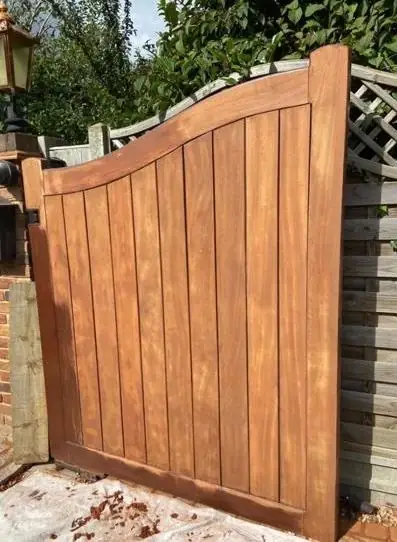
The council’s flood investigation after the 2024 floods describes Kislingbury’s ground plainly: the soil is mostly clayey and the bedrock is mudstone of low permeability, so the ground saturates easily. The land rises slightly to the south and surface water runs north through the village towards the Nene. Environment Agency mapping cited in the report gives the Beech Lane, Bugbrooke Road and High Street properties affected in 2024 a high chance of surface-water flooding, over 3.3% a year.
For garden timber that means the bottom of every fence is wet for long spells. Posts, gravel boards and the lowest rail of a panel stay damp, grow algae and soften long before the top of the fence does. So on a Kislingbury fence the preparation concentrates at ground level:
- Clear soil, leaves and grass back from the bottom of panels and gravel boards so air can get to them.
- Wash off algae and moss with a fungicidal cleaner and let the timber dry out properly, which on clay ground can take days.
- Check posts at ground level for soft wood; a stain will not save a rotten post.
- Work the stain into end grain and the bottom edges of boards, where water gets in first.
- Choose a breathable, water-repellent stain rather than a film-forming paint, so trapped moisture can escape instead of lifting the coating.
Long boundaries and the field edge
Kislingbury has more fence per house than most places. At the 2021 Census 45.0% of homes in the parish were detached, against 31.7% across West Northamptonshire, and detached houses mean long side and rear boundaries. On the edge of the village, gardens back onto open farmland to the east and the floodplain to the north and west, as the neighbourhood plan describes. Fences facing open fields take the full force of the weather, dry out fast in summer sun and turn grey quickly, while those along the floodplain stay damp. On a long boundary it is common for one side to need much more work than the other, and we look at each run separately at the quote rather than pricing a fence as one length.
Timber gates in ironstone and brick walls
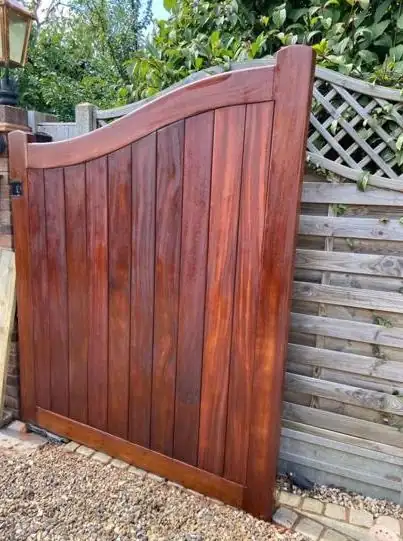
In the old village the boundary is usually a wall, not a fence. The conservation area appraisal records many listed or noted boundary walls on Camp Lane, Church Lane, High Street, Hodges Lane, Mill Road and Starmers Lane, in ironstone, brick and, at the churchyard, cob. The timber in those gardens is the gate set into the wall, plus perhaps a side gate and a garden door. Every character area in the appraisal asks for traditional details to be kept, and a solid painted or stained timber gate in a stone wall is one of them.
Gates in walls have their own weak points. The hanging stile sits against damp stone and stays wet; hinges and latches rust and stain the timber; and the bottom rail sits close to a path that may hold water. We ease and oil the ironmongery, treat the stile and bottom rail with extra coats, and keep stain off the stone. Where a gate is hardwood, it needs a different, more penetrating product from softwood.
New Pembleton fences: give them a season
The 44 Pembleton homes off Rothersthorpe Road, with first sales recorded from 2022 to 2024, came with new garden fences, and more will follow on the 48 homes approved west of Rothersthorpe Road in December 2025. New pressure-treated timber is often still damp and carries a factory finish when it goes in. Staining it straight away usually wastes the stain, because it cannot soak in. After a season of weathering, once the wood has dried and the surface has opened up, it takes a stain evenly. That is the time to choose a colour and protect it, before the grey sets in.
Our main fence and gate staining page covers products and finishes in general, and the guide to the exterior painting season explains timing. For metal gates, see the Kislingbury metal gates page, or the Kislingbury area page.
Sources
- Flood Investigation Report: Kislingbury (Section 19), West Northamptonshire Council, via Kislingbury Parish Council (accessed 2026-11-16)
- Census 2021 TS044 Accommodation type, Kislingbury output areas, ONS via Nomis (accessed 2026-11-16)
- Kislingbury Neighbourhood Plan 2014-2029, Kislingbury Parish Council (accessed 2026-11-16)
- Kislingbury Conservation Area Appraisal and Management Plan (January 2014), West Northamptonshire Council (accessed 2026-11-16)
- Price Paid Data: new-build sales in Kislingbury, HM Land Registry (accessed 2026-11-16)
- 2024/5562/MAF: land west of Rothersthorpe Road, Kislingbury, OpenGovernment (accessed 2026-11-16)
- Pembleton, Kislingbury, Spitfire Homes (archived December 2023), WhatHouse, via the Internet Archive (accessed 2026-11-16)
Last updated .


