DH Painter & Decorator covers Kislingbury, a village of about 1,240 people in NN7, roughly 3.6 miles west of Northampton town centre. Dean paints and decorates its listed ironstone cottages and larger 18th-century houses with breathable, sympathetic materials, as well as the later homes around the conservation area.
A stone village on the south bank of the Nene
Kislingbury sits on the south bank of the River Nene, west of Northampton and on the town’s side of the M1, with junction 16 about two miles away and the A4500 just to the north. It had 1,237 residents at the 2011 census and lies in the NN7 postcode area, now part of West Northamptonshire Council. We cover the village from our Northampton base, about 3.6 miles away.
The heart of the village is old. The Historic Environment Record describes an irregular western part with the church at the north end of a lane, and a near-rectangular grid of streets to the east, including the present High Street, which may have been a planned addition. Around St Luke’s Church, The Green, High Street, Mill Road and Church Lane, almost everything is built of coursed squared ironstone, and the area has been a conservation area since 1991, amended in 2014. Later housing surrounds that core. For a decorator, those two halves of the village call for quite different approaches.
Ironstone cottages from the 17th and 18th centuries
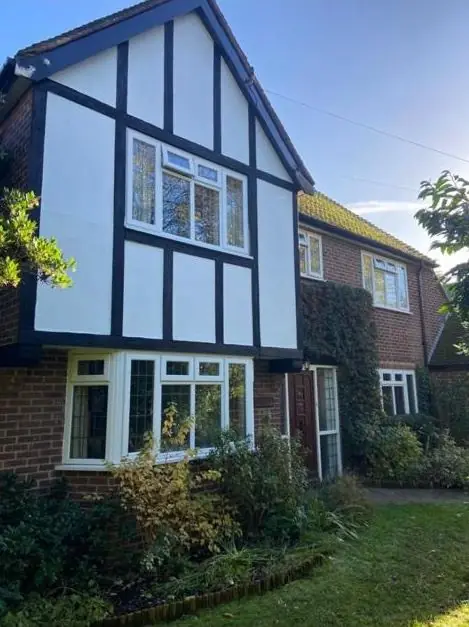
The listed houses are mostly late 17th or 18th-century work: cottages of two storeys plus an attic, laid out in two or three units and sometimes given a cross wing, roofed in slate, plain tile or, at The Sun Inn, thatch. They have brick end stacks, stone-coped gables with kneelers, and timber casements under wooden lintels, with stone mullion windows on some.
Outside, the stone itself is mostly left bare and should stay that way. Acrylic masonry paint on ironstone traps moisture and can damage the face of the stone, so the exterior work on these cottages is mainly joinery: casements, doors, lintels and gates. Old softwood needs flexible, microporous paint and careful preparation, and we never use heat guns near thatch. Our exterior painting service explains how we prepare and protect old timber.
Inside, expect chamfered spine beams, bressumers, uneven ceilings and original lime plaster. Lime walls need breathable clay or mineral paints, or limewash, rather than vinyl emulsion. Cutting in around beams is slow work, and attic rooms with sloping ceilings add more of it. Dean’s approach to these rooms is set out on the interior painting page.
The larger houses: sashes, doorcases and panelling
Grander houses went up in the 18th and early 19th centuries: The Old Rectory (Grade II*, built around 1710 to 1720), Kislingbury Hall on The Green, Nos. 12-14 High Street and Warwick House on Mill Road. These have ironstone ashlar fronts or coursed rubble with an ashlar face, stone bands and quoins, and 12- or 16-pane sashes. Kislingbury Hall has a painted classical doorcase.
Multi-pane sashes are some of the slowest painting work there is, because every glazing bar needs cleaning, filling, masking and cutting in by hand. Painted doorcases and panelled front doors suit oil-based or traditional finishes and colours in keeping with the period. Inside, fielded panelling and fine staircases need careful preparation and finishes chosen for the age of the room. Warwick House has a rendered plinth and quoins, and render patches on old stone need vapour-permeable coatings so they do not trap damp.
Listed buildings and what they mean for painting
The Kislingbury Conservation Area covers about 24 hectares and contains 27 listed buildings, from the Grade I Church of St Luke to Grade II cottages such as Yew Tree Cottage on School Lane, Vine Cottage on Church Lane and Bridge Cottage on Hodges Lane. Stone boundary walls line many of the lanes, including Camp Lane, Starmers Lane and Hodges Lane.
If you own a listed building, changing the external colour or the type of paint may need listed building consent. We did not find an Article 4 direction for the village in the sources we checked, but restrictions can still apply to some exterior alterations within the conservation area. Check with West Northamptonshire Council before a colour change. Repainting like for like in traditional, breathable materials is usually the simplest route. Our colour and finish advice can help you choose joinery colours that sit well against ironstone.
Living beside the river
Flooding is part of the village’s story. The Nene, on its northern side, damaged several houses in a serious flood in 1998, and attenuation works have been carried out since. The village sits on gravel at roughly 66 m above Ordnance Datum in the low Nene valley, and that affects painting in three ways:
- Ground floors near the river may have been re-plastered after flood damage. New plaster needs full drying time and a mist coat before any top coat, covered on our new plaster and extensions page.
- Walls that stay damp-prone need breathable coatings, not sealed ones.
- Sheltered elevations in low, damp ground dry slowly, so exterior timber work is booked for a settled, dry spell.
The mill buildings by the Nene are coursed Northampton sandstone and ironstone, both soft stones that rule out cement-based or impermeable coatings.
The Mill Road terrace and later homes
Nos. 24 to 44 Mill Road form a 19th-century terrace that the council has flagged as historically significant, and the 1828 Baptist chapel nearby has a slate roof and sashes. Beyond the historic core, the later houses are more conventional to decorate: modern plaster inside, standard fascias, soffits and softwood or uPVC joinery outside, with conventional render on some. These take standard emulsions and masonry paints, and work moves faster without the breathability and consent questions of the old stone houses. A 2017 assessment considered further housing on land at Rothersthorpe Road, on the village edge.
Most Kislingbury homes are owner-occupied (79.5% at the 2001 census), so most work here is planned maintenance by owners rather than turnaround between tenancies, although we also take on between-tenancy work when a let comes up.
Pubs, the village shop and small businesses
The commercial side of the village is small: a combined mini market and post office, three pubs of which Cromwell Cottage and The Sun Inn are listed, a cafe, a filling station and a few small businesses. Painting a listed pub frontage means heritage colours, signboards and joinery, often with work timed around opening hours.
Getting to you
The historic lanes, among them Church Lane, Starmers Lane, Hodges Lane, School Lane and Mill Lane, are tight, walled on both sides, with cottages hard up to the road. We plan van parking and ladder or scaffold positions before the job starts. The Bugbrooke road takes quarry lorries and Heygates flour mill traffic, which matters when working on a street-facing elevation. From Northampton the easy route in is the A4500, which avoids the narrow five-arch stone bridge to the north.
Ring Dean on 07539 779 036 for a visit and a free written quote. We are fully insured, and every quote is itemised so you can see what each part of the job involves.
Last updated by Dean, DH Painter & Decorator.