DH Painter & Decorator applies decorative finishes in Walgrave, NN6, about 7.9 miles north-east of Northampton. In the village's older stone houses that usually means limewash, flat distemper-style paints and traditional detailing, while the later estates suit feature walls and panelling.
Traditional finishes for houses built of lias
Walgrave’s historic houses date from the mid 17th to the early 19th century and are built of coursed lias, a local limestone. Walgrave Hall, in the north of the village, still has a plaster coat of arms of the Langham family dated 1674 and a staircase of about 1630, which gives a sense of how far back some of these interiors go. In houses like these, a glossy modern feature wall usually looks out of place. The finishes that suit them are the ones the walls were made for.
- Limewash builds up in thin, translucent coats and dries to a soft, chalky surface with gentle variation in tone. It lets lime plaster and stone breathe, and it can be tinted with earth pigments to sit with the brown lias.
- Distemper-style flat paints give the powdery, light-absorbing look of early decoration on ceilings and walls, without the sheen of vinyl emulsion.
- Clay and mineral paints give a velvety matt finish with a little depth, and they suit rooms where limewash would rub off too easily.
Where limewash is already on a wall, more limewash is the right follow-up. Putting acrylic paint over it seals the surface and tends to peel. If the house is one of the parish’s 18 listing entries, check any change of finish with West Northamptonshire Council first.
Picking out joinery, panelling and period detail
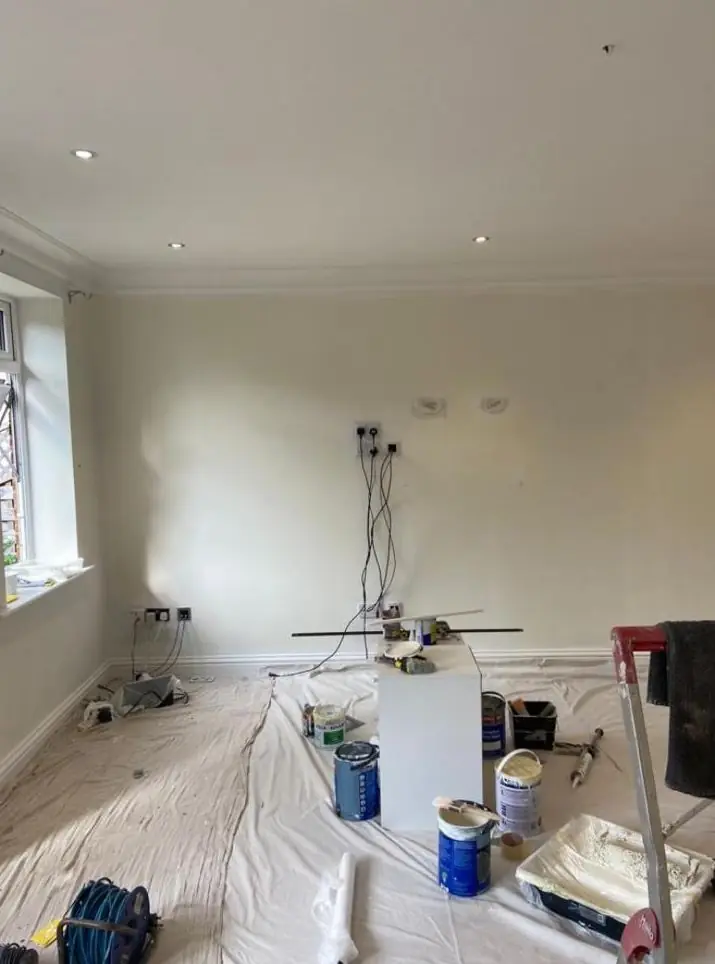
Older Walgrave houses carry plank and panelled doors and deep skirtings, and the higher-status buildings, such as Walgrave Hall Farmhouse with its stone mullion and transom windows, call for a more formal treatment around the openings. Picking these out in a second tone of the wall colour, or a quiet contrast, shows off the joinery without making it look new. Old joinery here may carry lead-based paint in its lower layers, so we test before preparing it and use wet methods or chemical stripping if lead is found.
Houses from around 1929 on Jubilee Drive, and from around 1949 on Townsend Road and Springfield Road, often keep their picture rails and original doors. A picture rail is a natural line for a two-tone wall, with the upper band and ceiling in one colour, or for a paper below and paint above.
Feature walls and new panelling in later homes
The homes on Amber Drive, built around 1975, and the infill closes such as Walker’s Acre, Church View and Manor Farm Close have straighter walls and plainer rooms, which suit modern effects. Typical jobs there include:
- Painting newly fitted shaker or wall panelling so joints, pins and mitres disappear.
- Colour-blocked or two-tone walls, including arches behind a bed or desk.
- A deep feature colour on a chimney breast or one end wall.
Time, patience and a dry day
Outside, decorative work in Walgrave is mostly limited to walls that already carry limewash. Bare coursed lias on the listed houses should stay bare, and painting stone that has never been painted on a listed building would need consent, so we won’t suggest it as a finish. Limewash and layered finishes take more coats and more drying time than standard emulsion, and limewash needs damp-curing between coats. As Walgrave is a full-day trip from Northampton, we plan the coats around one another and agree the drying gaps with you at the start, so nothing is rushed to finish early. For outdoor limewash on a wall that has already been limewashed, we wait for mild, dry weather without frost.
See our decorative finishes service for the full range of effects, or our Walgrave area page for other painting work in the village. The cost guide explains why layered finishes take longer to price than a flat repaint.
Last updated by Dean, DH Painter & Decorator.