
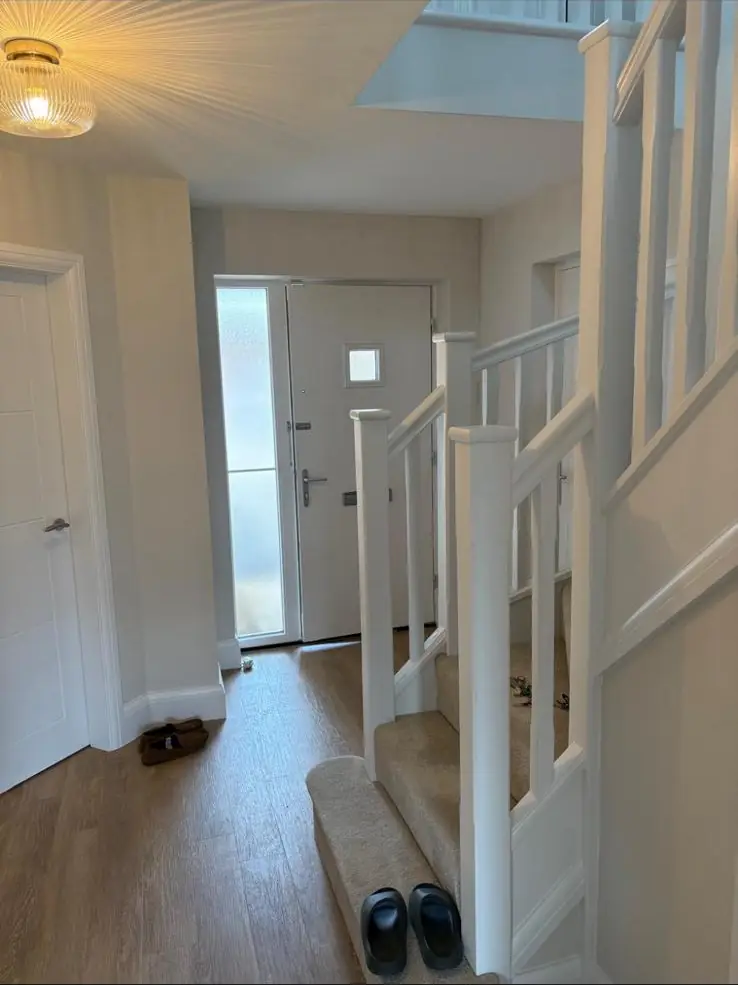
DH Painter & Decorator paints the inside of homes in Yardley Hastings, NN7, about 7.3 miles east of Northampton town centre. Many of the village's older houses are two storeys with an attic, built of solid limestone, so the work covers sloping ceilings and breathable paints as well as ordinary repaints in the postwar houses.
Painting rooms under the roof
Read through the listing descriptions for Yardley Hastings and one phrase keeps coming up: “2 storeys and attic”. The Manor House, 1 Castle Ashby Road, 3 and 5 Little Street, 79 High Street, and Fernbank and Glebe Farmhouse on Little Lane are all described that way, and the 2015 conservation area appraisal notes that roof lights and gable windows have been added across the village to bring attic space into use. So a bedroom here is often a room with a sloping ceiling, a low knee wall on one or both sides and a deep reveal round a dormer or roof light. Those rooms take longer than their floor area suggests. Every junction between slope, flat ceiling and wall is cut in by hand, and a roof-light reveal collects condensation, so it often needs a stain block before the finish coat.
Many of those roofs are steep because they were thatched until the 19th century, when most cottages were re-roofed in Castle Ashby pantile or slate and kept the old pitch. A steep roof gives a tall attic, and a tall attic has far more sloping ceiling to paint than a room under a shallow modern roof. Dean measures the slopes separately when he measures up, which is one reason a quote for an attic room here can differ from one for a box bedroom of the same size; our cost guide explains what else moves a price.
| Type | Share |
|---|---|
| Detached | 38.8% |
| Semi-detached | 32.1% |
| Terraced | 27.3% |
| Flat or maisonette | 1.8% |
Source: Census 2021 (ONS), accommodation type (TS044) tables via Nomis. The figures are for the census area that best fits Yardley Hastings, so its edges are not exactly Yardley Hastings’s.
Solid limestone, lime plaster and beams
The village stands on Blisworth Limestone, and nearly every listed house and cottage is built of coursed limestone rubble. Inside, the walls are solid, with no cavity, and in the older cottages they are finished in lime plaster. Lime needs to let moisture move through it. A vinyl emulsion seals the surface, and on a solid wall that can lead to blistering and flaking, so on lime plaster we use a breathable mineral or clay-based emulsion and keep the vinyl paints for modern plaster. Several listings also record chamfered spine beams across the ceilings. A bare beam has to be cut round cleanly, and the old ceiling plaster beside it is often soft, so it is consolidated before painting rather than rolled over.
Heating plays a part too. Census 2021 figures for the parish show 4.5% of homes on oil alone, 4.8% on electricity alone and 12.7% on two or more systems, which in an old cottage often means a stove alongside the boiler. A room with a stove usually shows soot shadowing above the fireplace and across the ceiling, and a room heated less often shows mould where a cold wall meets the ceiling. Both are cleaned and sealed first, or the marks come back through new paint within weeks.
Which house you live in decides the paint
Yardley Hastings is really two kinds of housing. About 36% of homes in the area covering the village, Denton and Castle Ashby were built before 1900, according to the Valuation Office Agency, against about 12% across West Northamptonshire. Most of the rest is 20th-century: the council houses on the Leys from 1935, the 1962 bungalows on Castle Ashby Road and the later houses on Highfield Way.
| House | Walls and ceilings | What we use |
|---|---|---|
| 17th and 18th-century cottages: High Street, Little Street, the Square | Solid limestone, lime plaster, beams, attic rooms | Breathable emulsion, hand cutting-in, stain block where needed |
| Late-17th-century farmhouses such as Fernbank and Glebe Farmhouse | As above, larger rooms, listed | Breathable paint; consent check before any change of finish |
| Estate brick houses, e.g. 20 and 22 Little Street (1905) | Brick with older plaster | Test for lime or gypsum first, then choose the paint |
| The Leys (1935), Highfield Way, the bungalows | Gypsum plaster or plasterboard | Standard emulsions; durable finishes in kitchens and halls |
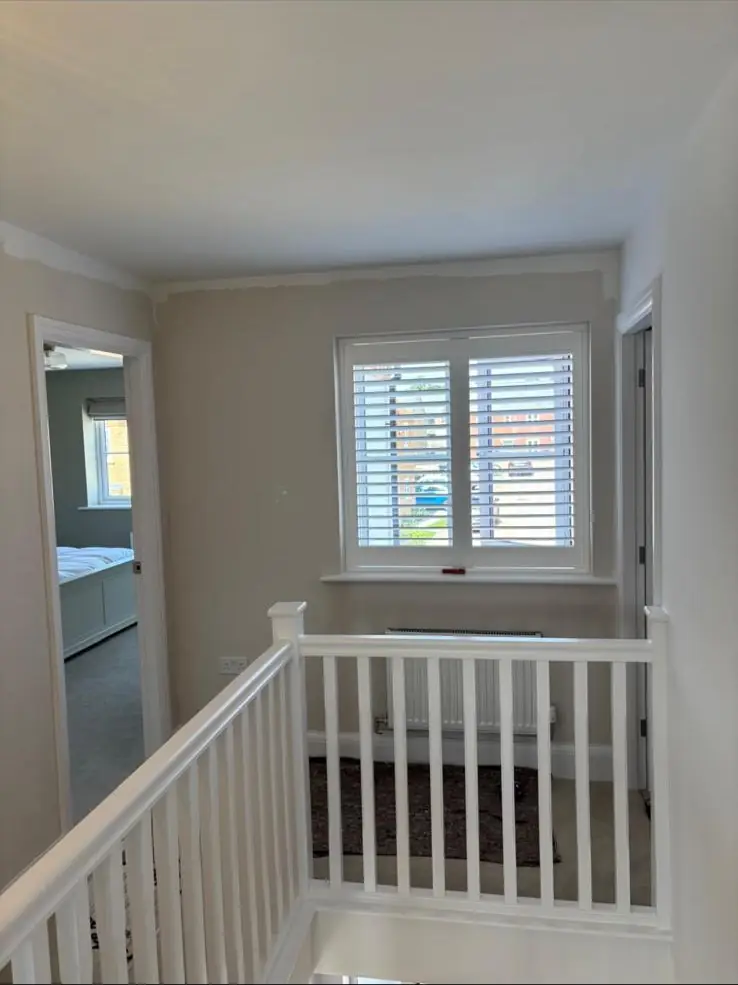
The homes are bigger than the county average as well. A third of households (33.4%) have four or more bedrooms, against 27.3% across West Northamptonshire, so a whole-house repaint usually means more rooms, and more landing and stairwell, than people budget for. The stairs are covered on our page about hallway and stairs decorating in Yardley Hastings.
| Fact | Detail | Source |
|---|---|---|
| Listed houses of ‘2 storeys and attic’ | Manor House, 1 Castle Ashby Road, 3 and 5 Little Street, 79 High Street, Fernbank, Glebe Farmhouse | British Listed Buildings |
| Homes with four or more bedrooms | 33.4%, against 27.3% across West Northamptonshire (Census 2021) | Nomis (ONS) |
| Homes using two or more heating systems | 12.7%; oil only 4.5%, electric only 4.8% (Census 2021) | Nomis (ONS) |
| Building stone | Blisworth Limestone, laid as coursed rubble | West Northamptonshire Council |
| Homes built before 1900 | About 280 of 770 in the Yardley Hastings, Denton and Castle Ashby area (VOA 2025) | GOV.UK |
Do listed interiors need permission to paint?
Yardley Hastings has 23 listed buildings, and listing covers the inside as well as the outside. Repainting a room in a like-for-like finish is usually treated as maintenance, but painting over bare beams or historic plaster, or stripping it, can need listed building consent from West Northamptonshire Council. If your house is one of the listed cottages on Little Street, Little Lane or High Street, Dean will point out anything he thinks should be checked before he quotes. Our main interior painting page covers how we prepare and protect a lived-in house, and the Yardley Hastings area page sets out the village’s other decorating work.
Interior painting in Yardley Hastings: common questions
Something not covered here? Call Dean on 07539 779 036.
Why does painting an attic bedroom in a Yardley Hastings cottage take longer than a normal room?
Many older houses here were built with two storeys and an attic under steep roofs that once carried thatch. The rooms have sloping ceilings, knee walls and dormer or roof-light reveals, and every junction is cut in by hand. Reveals round roof lights often carry condensation staining that needs sealing first. The floor area is small, but the paintable surface is large.
Can I use ordinary emulsion on the walls of my limestone cottage?
On original lime plaster over solid limestone, it is better not to. Vinyl emulsions seal the wall and trap moisture, which then pushes the paint off as blisters or flakes. We use breathable mineral or clay-based emulsions there. Modern gypsum plaster, as in the Leys houses, Highfield Way and later extensions, takes ordinary emulsion without any problem.
My cottage has a wood burner. Will the soot marks show through new paint?
They will unless they are dealt with. Soot and smoke staining is washed down, then sealed with a stain-blocking primer before the finish coats. It is a common job in Yardley Hastings, where Census 2021 recorded 12.7% of homes using two or more heating systems. Cooler, less-heated rooms get checked for mould at the same visit.
Do you paint the inside of the 1930s houses on the Leys as well as the old cottages?
Yes. The Leys was built by the local authority in 1935 and has conventional plastered rooms, so it takes standard emulsions after the usual filling, sanding and caulking. The same goes for Highfield Way and the Castle Ashby Road bungalows. We cover the whole village from Northampton, about 7.3 miles to the west.
Sources
- Listed buildings in Yardley Hastings, British Listed Buildings (accessed 2026-11-16)
- Yardley Hastings Conservation Area Appraisal and Management Plan (adopted April 2015), South Northamptonshire Council (now West Northamptonshire Council) (accessed 2026-11-16)
- Census 2021 TS050: number of bedrooms, Yardley Hastings output areas, Nomis (ONS) (accessed 2026-11-16)
- Census 2021 TS046: central heating, Yardley Hastings output areas, Nomis (ONS) (accessed 2026-11-16)
- Council tax: stock of properties by build period, 2025 (CTSOP4.1), Valuation Office Agency (accessed 2026-11-16)
- Census 2021 TS044: accommodation type, Yardley Hastings output areas, Nomis (ONS) (accessed 2026-11-16)
Last updated .


