We hang wallpaper in Abington, a district about 1.6 miles north-east of Northampton town centre around Abington Park. Most papering here goes into Victorian terraces and early-1900s park-side houses, where tall walls and picture rails suit period designs but old plaster is rarely straight.
Picture rails decide the layout
A lot of Abington’s older houses still have a picture rail running round the room, a little below the ceiling. In the terraces off the Wellingborough Road and the larger houses facing the park, that rail splits the wall into two zones, and the first question on any papering job is what happens to each. Some people paper from skirting to rail and paint the frieze above in a ceiling colour. Others take a paper right up to the cornice and let the rail sit on top of the pattern. Both work. What matters is that the decision is made before rolls are ordered, because the drop length, the waste on each length and the number of rolls all change.
Where the rail has been removed at some point, there is usually a filled scar along the wall. Under a plain or fine-textured paper that line can telegraph through, so we sand and fill it flat or cover it with a lining paper first.
Walls that were never straight
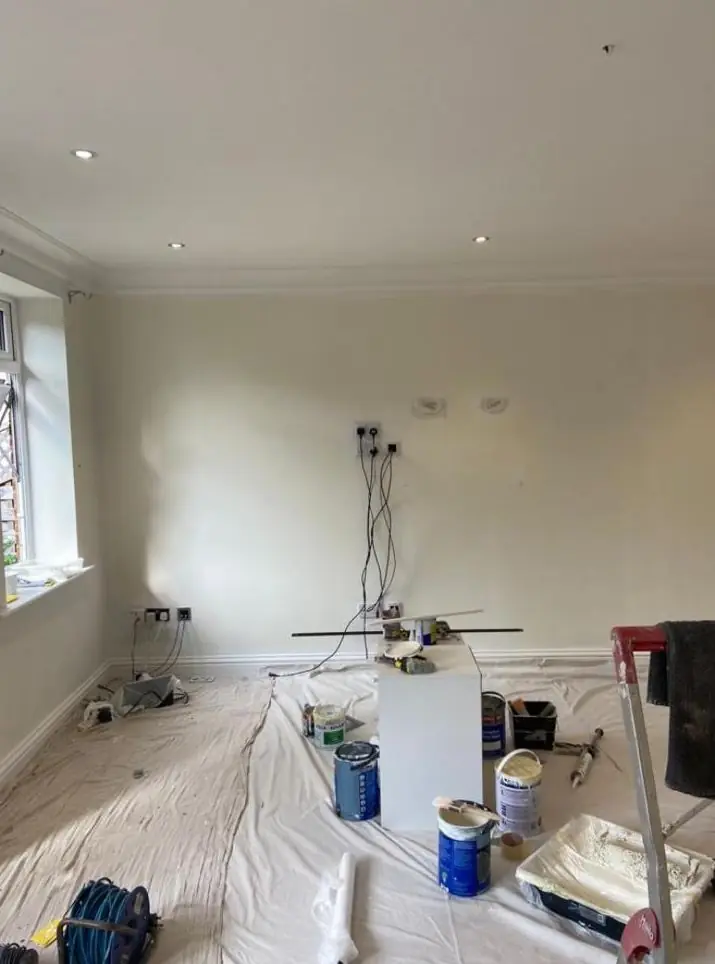
Victorian and Edwardian plaster in this part of Northampton was hand-applied, and over a hundred years houses settle. Corners drift out of plumb, chimney breasts lean, and the wall between a bay and the party wall might bow by a noticeable amount. A striped paper will expose all of it. A loose, all-over pattern will hide most of it.
Our routine on these walls:
- Hang a plumb line from the centre of the main feature, usually the chimney breast, and work outwards in both directions so any drift ends up in the least visible corner.
- Line the wall horizontally where the plaster is crazed or patched, so the finish paper sits on an even base.
- Scribe lengths to the cornice and skirting by hand rather than trusting a straight cut.
- Plan where the last length lands so the pattern break falls behind a door or in an alcove.
Chimney breasts and alcoves in the terraces
In a Victorian terrace front room the chimney breast is usually the centre of the room, with an alcove either side. That gives you four external corners and two internal ones in a short run of wall. Each wrap around a corner is a chance for the pattern to wander, so lengths are cut and wrapped no more than a short distance round the corner, and the next length is re-hung to plumb with a slight overlap matched by eye. Large-repeat papers lose more to waste here than in an open room, which we factor into the roll count.
Tight front halls in these houses are also the route for everything coming in and out, since some, as recorded for Cedar Road, have no usable rear access. If the hall itself is being papered, we leave it until last.
Papering in converted flats and HMOs
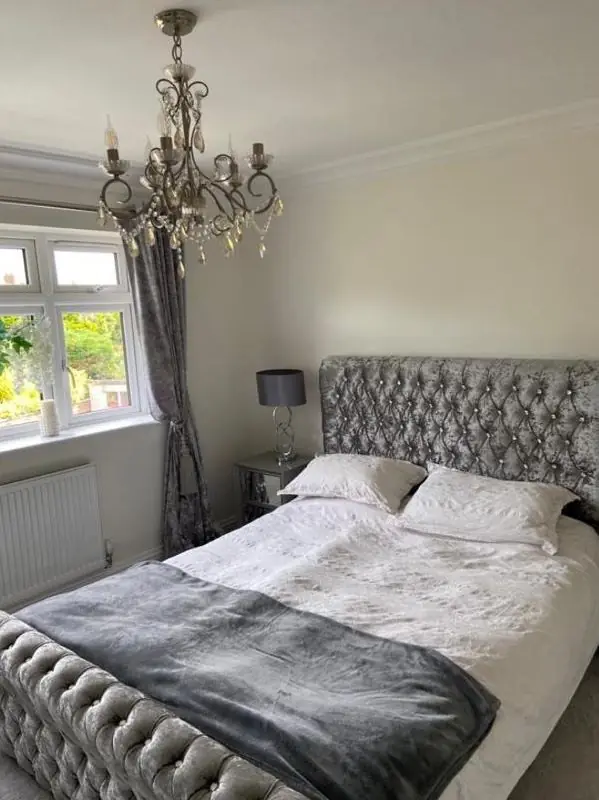
A lot of Abington property has been split into flats or let as shared houses. Landlords rarely want delicate paper in a shared hallway, but a tenant-proof option does exist: a heavy vinyl or non-woven paper in kitchens and halls wipes clean and is easier to patch than emulsion. In flats made from older industrial buildings, walls can be very tall and may mix new board with old masonry, which is another case for lining first. Our main wallpaper hanging page covers paper types and stripping in more detail.
Getting started
Dean measures each wall on site, checks the plaster and talks through where the pattern should start before you order paper. See our Abington page for other work we cover nearby, and our cost guide for what affects the price.
Last updated by Dean, DH Painter & Decorator.